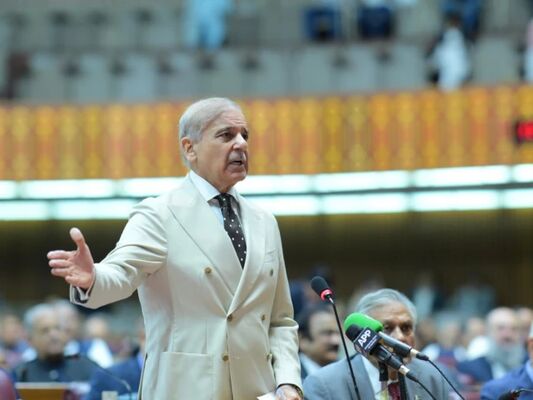
Prime Minister Shehbaz Sharif on Tuesday defended his government’s legitimacy in the National Assembly and challenged opposition criticism. He argued that if the 2018 general election was accepted as legitimate, the current government deserved the same recognition. The remarks are significant as political tensions continue over electoral credibility and democratic governance in Pakistan.
Speaking during the debate on the Finance Bill 2026-27, the prime minister responded to opposition leader Mahmood Khan Achakzai’s allegations that the government was illegal. Shehbaz said any inquiry into election legitimacy should begin with the 2018 polls. He maintained that if no evidence of manipulation emerged from that review, similar standards should apply to the present administration.
The prime minister also rejected claims that development policies favored larger provinces at the expense of smaller regions. He stressed that national progress could only be achieved when Punjab, Sindh, Balochistan, and Khyber-Pakhtunkhwa advanced together. According to Shehbaz, development limited to a single province could not be considered progress for Pakistan as a whole.
Prime Minister Muhammad Shehbaz Sharif addresses the National Assembly Session (23 June, 2026). pic.twitter.com/X0fspwhltd
— Prime Minister’s Office (@PakPMO) June 23, 2026
Turning to foreign affairs, the premier highlighted Pakistan’s diplomatic efforts in facilitating dialogue between Iran and the United States. He said an understanding had been reached through talks hosted in Switzerland and noted that a ceasefire was now in place. Furthermore, he said technical negotiations would continue over the next 60 days on key issues, including nuclear facilities, ballistic missiles, and frozen assets.
Meanwhile, Achakzai urged the government to engage more actively with political stakeholders, particularly in Balochistan. He criticized parliamentary procedures, judicial reforms, and the treatment of political prisoners, while calling for stronger constitutional adherence. The opposition leader also emphasized that Parliament should remain the primary source of democratic authority in the country.