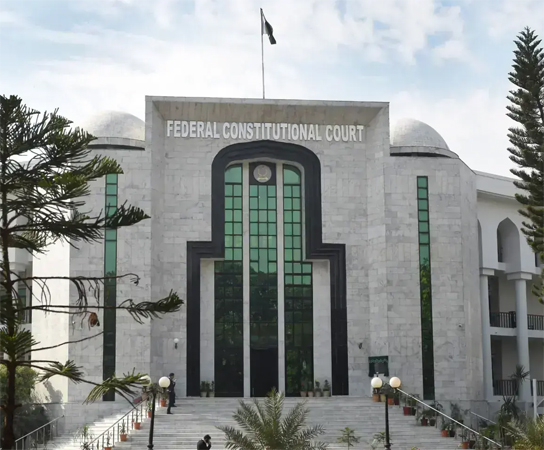
The Federal Constitutional Court (FCC) has dismissed the Khyber Pakhtunkhwa (KP) government’s appeal against the appointment of a master’s degree holder as a sanitary worker, upholding an earlier decision by the Peshawar High Court.
Read More: FCC upholds ruling against additional charge of sub-registrar posts
A three-member FCC bench headed by Justice Hassan Azhar Rizvi heard the case on Thursday. During proceedings, a district education officer appeared before the court and informed judges about the duties being performed by the employee, who had been working as a sanitary worker despite holding a master’s degree.
Justice Rizvi expressed concern over the situation and questioned the practice of assigning highly educated individuals to jobs far below their qualifications. He remarked that it was a serious issue that a person with an MA degree was being asked to perform sweeping and cleaning duties.
The judge asked the official what responsibilities the employee was carrying out, to which the officer replied that his work involved cleaning and sanitation tasks.
Justice Rizvi criticized the system, saying that it was unfortunate that an educated young person had been placed in such a role. He observed that removing the employee after a decade of service would not be an appropriate solution and directed the provincial government to consider assigning him a position more suitable to his educational background.
During the hearing, the KP additional advocate general informed the court that no vacant posts for sanitary workers were currently available in the province.
Justice Rizvi questioned the claim and made a sarcastic remark about whether the province had become so clean that it no longer required sanitation staff.
The FCC later dismissed the provincial government’s appeal and maintained the Peshawar High Court’s ruling. The court directed authorities to explore options for providing the petitioner with a role matching his qualifications while ensuring his employment rights remain protected.
Read More: FCC declares certain interim government appointments in KP illegal
The case has highlighted broader concerns about unemployment, underemployment and the mismatch between educational qualifications and available job opportunities in Pakistan.